
One Last Fastball: Justin Verlander's Career Ends Where It Began, With His Daughter by His Side
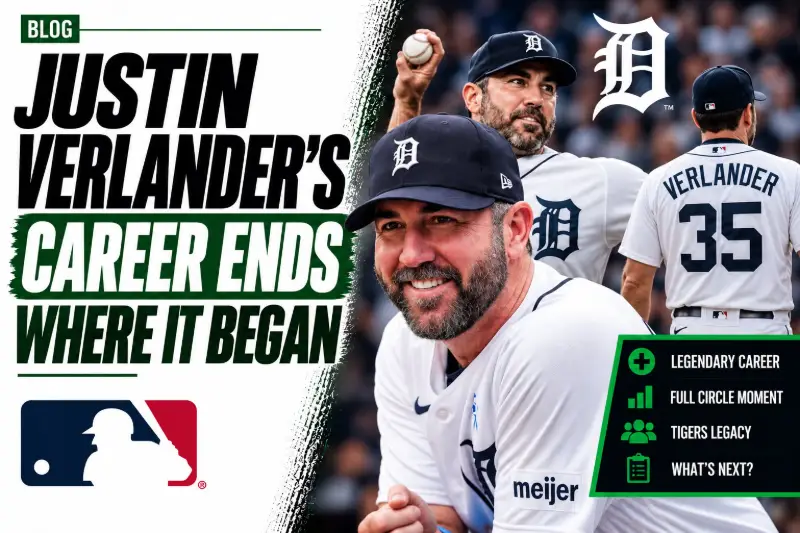
When Numbers Don't Tell the Whole Story
There are baseball moments you remember because of the numbers. The perfect game. The 300th win. The no-hitter. These are the statistics that echo through the ages, the milestones that define careers and secure legacies.
Then there are moments when the numbers don't matter at all.
On September 26, 2026, at Comerica Park in Detroit, one of those moments unfolded. After 21 Major League seasons, 266 victories, three Cy Young Awards, and countless accolades, Justin Verlander walked off a Major League mound for the final time. There would be no next start. No next season. No more chasing another championship or another milestone.
And fittingly, Verlander didn't walk off the mound alone. His 7-year-old daughter, Genevieve, came running out to get him.
Back Where It All Started
If Justin Verlander's career had to end anywhere, Detroit was the only place that made sense.
The Tigers selected Verlander with the No. 2 overall pick in the 2004 MLB Draft, and he made his Major League debut on July 4, 2005. From that moment forward, Detroit watched a hard-throwing young pitcher develop into the unquestioned ace of a generation. The milestones came quickly and consistently:
- 2006 American League Rookie of the Year Award
- First career no-hitter at Comerica Park in 2007
- 2011: A historic season with a 24-5 record, 2.40 ERA, AL Cy Young Award, and American League MVP, a rare accomplishment for a starting pitcher
Eventually, Verlander's career took him beyond Detroit. There were World Series championships in Houston, a stop with the Mets, and a season in San Francisco. He became a global icon, a pitcher who competed at the highest level across different franchises and different eras of baseball.
But in 2026, the story came full circle. Verlander returned to the Tigers for one final season. He wanted to finish where everything started. He wanted to come home.
A Final Season That Didn't Go According to Plan
The final season wasn't the victory lap everyone might have imagined. Injuries largely took that away.
Hip and hamstring problems kept Verlander off a Major League mound for nearly six months after his first start of the season on March 30. At 43 years old, simply getting healthy enough to pitch one more time became an accomplishment in itself. The body that had carried him through two decades of professional baseball was finally showing its age.
There was no traditional rehab assignment before his finale. Verlander essentially accelerated his comeback because there wasn't another season waiting for him. There was only one more start. One more afternoon wearing the Old English D. One more chance to stand on the mound at Comerica Park and feel the roar of the crowd.
And somehow, after everything his body had been through, Verlander gave Detroit one final glimpse of the pitcher Tigers fans had remembered all these years.
Vintage Verlander, One Last Time
Against the Pittsburgh Pirates, Verlander didn't look like a pitcher simply making a ceremonial appearance. He competed. He battled. He showed why he had dominated Major League Baseball for over two decades.
Verlander threw 5⅓ innings, allowing two runs on five hits while striking out six and walking one. He threw 91 pitches. Think about that for a moment. He was 43 years old. He had gone six months without appearing in a Major League game. His preparation had been limited. And Justin Verlander still went out and battled Major League hitters for more than five innings.
Even the fastball still had something left. The velocity might not have reached the triple digits of his youth, but the precision was there. The competitive fire was there. The legend was still there.
Everyone inside Comerica Park knew the moment was coming. Eventually, manager A.J. Hinch was going to have to walk onto the field and take the baseball from Verlander's hand for the final time. The end of an era. The conclusion of one of baseball's greatest careers.
Except Hinch had something else planned. Something that would transform a final game into a moment that transcended statistics and championships.
"Dad, It's Time"
Verlander recorded the first out of the sixth inning when Brandon Lowe popped out behind home plate. That was it. The end had arrived.
Hinch emerged from the Detroit dugout, walking slowly toward the mound. The crowd sensed what was happening. The energy shifted. This was it, the final moment of a legendary career.
But then Hinch stopped.
Instead of approaching the mound himself, he turned back toward the dugout. And then Genevieve Verlander came running toward the mound.
Verlander hadn't been told. His daughter ran across the field wearing her father's Tigers jersey, reached the mound, and wrapped her arms around him. The pitcher who had stared down postseason lineups, thrown three no-hitters, and spent more than two decades refusing to show weakness on a mound couldn't hold it together anymore.
Verlander sobbed.
He later said the surprise had completely blindsided him and that he had to explain to Genevieve that he was crying because he was happy. For all the strikeouts, victories, and trophies, this became the lasting image of his final game. Not a 100-mph fastball. Not a strikeout. Not a Cy Young trophy.
A father holding his daughter.
Hinch eventually approached Verlander and officially ended his afternoon, and his career. Then Verlander began the longest and perhaps most meaningful walk back to the Tigers dugout he had ever taken. This time, he walked off with Genevieve, hand in hand, leaving the game together.
Baseball Came Full Circle
There was something almost impossibly perfect about it all.
When Verlander arrived in Detroit more than two decades earlier, he was a 22-year-old kid with an electric right arm and everything to prove. He left at 43 as a husband and father, his priorities fundamentally shifted from accolades to family.
Hinch explained afterward why including Genevieve mattered so much. During conversations with Verlander over the years, he had seen how much pride Verlander took in being a father. It wasn't just about the pitching. It was about the person behind the pitcher.
For Genevieve, the man standing on that mound wasn't a three-time Cy Young winner. He wasn't an MVP. He wasn't one of the greatest strikeout pitchers baseball has ever seen. He was Dad. And she got to bring Dad home.
An All-Time Career in Numbers
Now we can finally look at the numbers that defined his legacy:
- 266 victories across 21 Major League seasons
- 3,560 strikeouts, eighth on MLB's all-time list
- Three Cy Young Awards
- 2011 American League MVP Award
- 10 All-Star selections
- Three no-hitters
- Two World Series championships
It's a résumé that tells the story of one of the defining starting pitchers of the 21st century. A pitcher who evolved, adapted, and competed at the highest level for over two decades. A pitcher who refused to decline gracefully and instead fought for every out.
But Detroit fans know his career was about more than statistics. They remember the intensity. They remember the fastball getting harder as games went deeper. They remember October. They remember 2011. They remember the no-hitter at Comerica. And now they'll remember September 26, 2026.
One Last Gift From Detroit
The Tigers weren't finished giving Verlander a proper goodbye.
Detroit entered the ninth inning trailing Pittsburgh 3-1. The game looked lost. The final chapter seemed to be closing with a defeat. But then the Tigers rallied. With two outs, rookie Eduardo Valencia launched a two-run walk-off home run, giving Detroit a dramatic 4-3 victory on the afternoon of Verlander's final start.
Of course they did.
Because on this afternoon, baseball apparently decided subtlety wasn't necessary. The script wrote itself. Verlander didn't earn career victory No. 267. He didn't need it. He had already gotten something considerably more meaningful, a perfect ending, a moment frozen in time, a memory that would outlast any statistic.
The Perfect Ending
Justin Verlander's career wasn't perfect. He has acknowledged that one thing he wishes he could have accomplished was winning a World Series championship with Detroit, the team that drafted him and believed in him first. That remains the one unfulfilled dream.
But careers aren't defined solely by what didn't happen. They're defined by everything that did. For 21 seasons, Justin Verlander competed against baseball's best. He survived injuries, aging, Tommy John surgery, and countless adjustments while evolving from a fireballing young ace into one of the most accomplished pitchers of his era.
And somehow, after all those years, baseball gave him the opportunity very few athletes receive: the chance to know when the final moment had arrived and to say goodbye on his own terms.
There will eventually be another ceremony. One day, Cooperstown will come calling. One day, Detroit will celebrate No. 35 again. But none of those moments will quite look like this one.
A little girl running toward the mound.
A legendary pitcher dropping his guard.
A father hugging his daughter.
And then the two of them walking away from the game together.
Justin Verlander spent more than two decades learning how to finish baseball games. On Saturday afternoon in Detroit, his daughter showed him how to finish a career. And there couldn't have been a better ending.