
Six Moves, One King: How LeBron's Next Decision Could Reshape the NBA
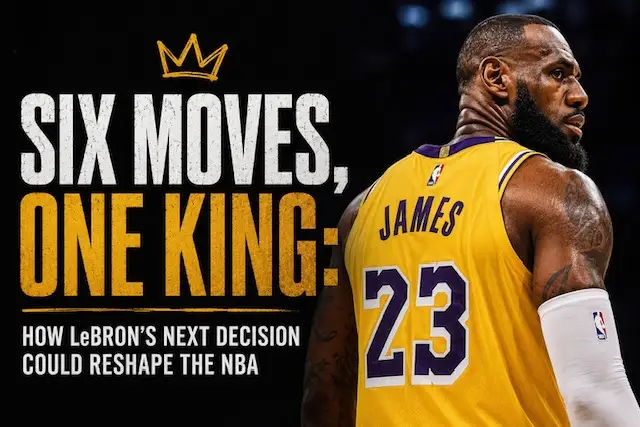
At 41 years old and 23 seasons into one of the most decorated careers in basketball history, LeBron James remains the center of the NBA universe.
Another postseason ended without a championship, but the conversation surrounding LeBron has never been about simple wins and losses. At this stage, every offseason decision carries league-wide consequences. His future is no longer just a roster question — it is a question about legacy, timing, identity, and how one of the greatest athletes the sport has ever seen wants to close the final chapter of his career.
Most aging superstars eventually drift out of the spotlight as the game moves on around them. LeBron has done the opposite. Even after more than two decades, the league still pauses when his name enters the rumor cycle. Front offices adjust plans. Television panels explode into debate. Fans convince themselves they suddenly understand salary cap mechanics because one possibility surfaced on social media.
That is what makes this summer different.
This is not simply about whether LeBron can still perform at a high level. He already answered that question. The real debate centers on what kind of ending makes sense now — for the player, the businessman, the father, and the global icon.
After a season that once again highlighted both his brilliance and the shrinking margin for error around him, LeBron enters an offseason with six realistic paths ahead. Some involve one last championship pursuit. Others lean into legacy and symbolism. One revolves around lifestyle continuity. Another centers on the possibility of walking away before the game ever forces him to.
Each option would alter the NBA landscape instantly.
Running It Back in Los Angeles
The most straightforward outcome remains a return to the Los Angeles Lakers.
From a basketball standpoint, the logic is easy to understand. LeBron already knows the organization, the expectations, and the pressure attached to wearing purple and gold. At his age, familiarity matters. Transitioning into a new system, new locker room, and new coaching structure would come with challenges that younger stars can absorb more easily.
Los Angeles also extends beyond basketball now. His family is settled there. His business ventures are deeply tied to the city. Remaining with the Lakers would allow him to continue balancing basketball with the broader empire he has built off the court.
The larger question is whether the franchise can still construct a legitimate championship roster around him. Another season exposed the same recurring issues: inconsistent perimeter shooting, defensive lapses, and stretches where the roster simply asked too much of LeBron to stabilize everything offensively.
If the Lakers can create meaningful roster flexibility, staying becomes the cleanest path forward. It would allow LeBron to pursue one final title run while preserving the continuity of the Los Angeles chapter of his career.
And from a legacy perspective, another championship in L.A. would further cement his standing within one of basketball's most historic franchises, even if his overall résumé long ago transcended any single organization.
Joining Forces With Stephen Curry in Golden State
Few scenarios would create more attention across the sports world than LeBron joining Golden State Warriors alongside Stephen Curry.
For years, LeBron and Curry defined an era through their Finals battles. The possibility of them becoming teammates instead of rivals would immediately become one of the most fascinating partnerships in modern NBA history.
Basketball-wise, the fit is undeniable.
Curry's gravity as a shooter would create space unlike anything LeBron has operated with in years. In return, LeBron's ability to control tempo, dissect defenses, and orchestrate offense would reduce the physical burden on Curry. Rather than carrying every possession, LeBron could operate more selectively and preserve energy for postseason moments.
At this stage of his career, that matters.
The Warriors also represent perhaps the clearest "ring-chasing" environment available outside Los Angeles. A veteran structure, championship experience, and an established offensive identity could allow LeBron to maximize efficiency rather than volume.
The narrative implications, however, would be enormous.
A partnership between LeBron and Curry would dominate sports discourse instantly. If they won a championship together, debates about legacy, all-time rankings, and the defining players of the generation would intensify overnight. If they fell short, criticism would arrive just as quickly.
Either way, the league would revolve around it.
A Third Chapter in Cleveland
A return to the Cleveland Cavaliers remains one of the most emotionally compelling possibilities available.
Unlike his previous two stints in Cleveland, this version would look entirely different. LeBron would not be returning to rescue a struggling franchise. Instead, he would join a younger core that already possesses structure, talent, and postseason expectations.
That distinction matters.
For the first time in Cleveland, LeBron could operate as the finishing piece rather than the entire foundation. A younger roster would allow him to preserve energy throughout the regular season while still controlling critical moments in playoff basketball.
There is also undeniable symbolism attached to the idea.
A third Cleveland chapter would feel less like free agency and more like basketball mythology. Every game would carry emotional weight. Every postseason moment would become part of a larger conversation about legacy, loyalty, and full-circle storytelling.
The Cavaliers option may not generate the same shock value as Golden State or the Clippers, but it arguably carries the strongest emotional resonance.
For many fans, it would feel like the most human ending available.
Crossing the Hall to the Clippers
The Los Angeles Clippers represent the most disruptive option on the board.
From a practical standpoint, the move makes sense. LeBron could remain in Los Angeles, maintain the same off-court lifestyle, and avoid uprooting his family or business commitments while entering a completely new basketball environment.
But the optics would be explosive.
A move across the hallway from the Lakers to the Clippers would immediately become one of the most polarizing free-agent decisions in league history. It would not be treated as a normal roster move. It would feel personal.
Every Lakers-Clippers matchup would instantly become must-watch television.
Basketball-wise, the Clippers could offer a different roster equation and potentially relieve some of the burden LeBron has carried in Los Angeles. The familiarity of staying in the same city while changing organizations also makes this one of the least disruptive lifestyle transitions available.
Still, the emotional fallout from Lakers fans would likely overshadow everything else.
The image alone — LeBron remaining in the same arena but wearing different colors — would dominate headlines for months.
A Reunion in Miami
A return to the Miami Heat initially sounds unlikely until the basketball logic begins to settle in.
Miami still represents one of the league's clearest organizational identities. Structure, accountability, conditioning, and championship expectations are embedded into the franchise culture. For an aging superstar looking to maximize his remaining years, that stability carries real value.
LeBron no longer needs to prove he can carry an entire league on his shoulders. At this point, fit and sustainability matter more.
Miami offers both.
The first Heat era defined LeBron's rise into a global villain and eventually a champion. A second stint would feel entirely different. This would not be about dominance or validation. It would be about extending greatness within a proven championship infrastructure.
And culturally, the reaction would be massive.
The moment LeBron appeared in a Heat jersey again, social media would instantly revisit the "Heatles" era. Old highlights would resurface. Comparisons between eras would flood television debates. The nostalgia factor alone would make the move one of the biggest stories in sports.
Walking Away on His Own Terms
Retirement remains the quietest option, but perhaps the most powerful one.
LeBron has already achieved virtually everything possible within the sport. Championships. MVPs. Longevity records. Cultural influence. Financial success. Global recognition. There is no unfinished résumé here.
What makes retirement compelling is timing.
Most legends do not get to choose their ending while still performing at an elite level. The game usually decides for them. Decline becomes visible. Production falls off. The conversation shifts from greatness to limitation.
LeBron still has the rare ability to leave before that happens.
There is enormous control in that decision.
Rather than staying long enough for the league to slowly move past him, he could step away while still commanding attention, still altering defensive game plans, and still carrying the aura of one of basketball's defining figures.
And retirement would not remove him from sports culture. His media presence, business ventures, and influence across basketball are already too large for that. He would simply transition into a different phase of visibility.
Still, his absence would fundamentally change the NBA.
An entire generation of basketball storytelling has revolved around LeBron James. Rivalries, championships, debates, and eras have all been framed around his presence. Whenever he eventually leaves the game, the league will feel different overnight.
What Fans Want Versus What Makes Sense
If fans were choosing the outcome, chaos would likely win.
LeBron joining Curry in Golden State. LeBron returning to Miami. LeBron switching to the Clippers. Those are the scenarios built for internet reactions, television debates, and nonstop discourse.
But realism often looks less dramatic.
Remaining with the Lakers or retiring may ultimately represent the most practical outcomes because both preserve stability while acknowledging where LeBron is physically and professionally at this point in his life.
That contrast is what makes this offseason so compelling.
Fans want spectacle. Players prioritize sustainability. The public wants cinematic endings, while the athlete himself has to weigh family, recovery, health, and whether another full season grind is still worth embracing.
The Bigger Picture
Ultimately, LeBron's six realistic paths fall into three categories.
The Lakers, Warriors, Clippers, and Heat represent the championship pursuit lane. Cleveland represents the emotional legacy lane. Retirement represents the control-the-ending lane.
Every option tells a different story about what matters most to him now.
Staying in Los Angeles would signal belief that the Lakers chapter still deserves a cleaner conclusion. Joining another contender would suggest maximizing one final title window above everything else. Returning to Cleveland would lean fully into symbolism and legacy. Retirement would represent ownership over the final page of an unprecedented career.
That is why this offseason carries unusual weight.
LeBron is one of the few athletes in sports history capable of shifting an entire league simply by making a decision. Even now, after all the mileage, all the playoff runs, and all the years under the spotlight, the NBA still feels like it pauses waiting for his next move.
And perhaps that is the clearest reflection of his greatness.
The season may have ended without a championship, but the league's biggest story still begins and ends with LeBron James.